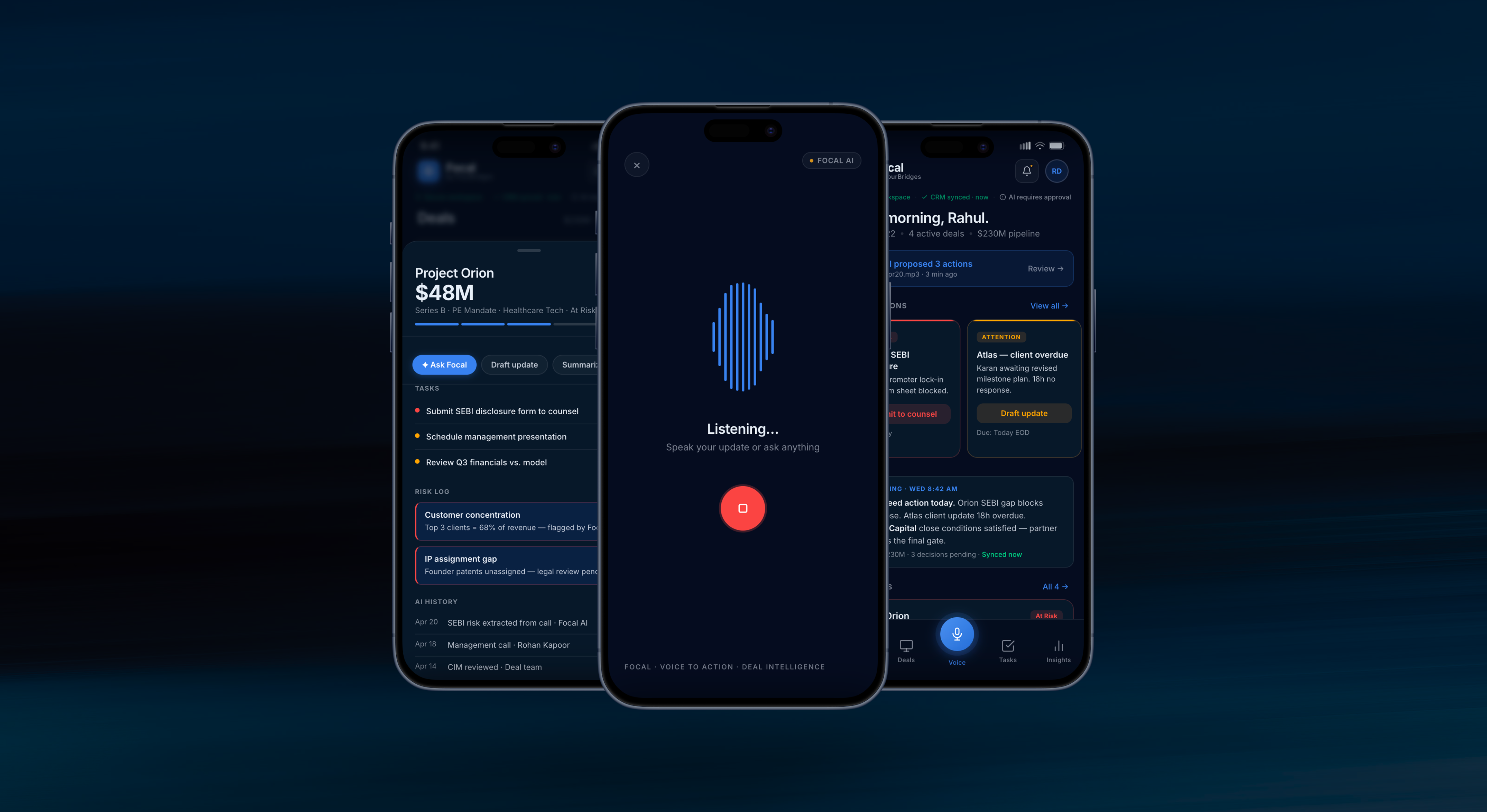
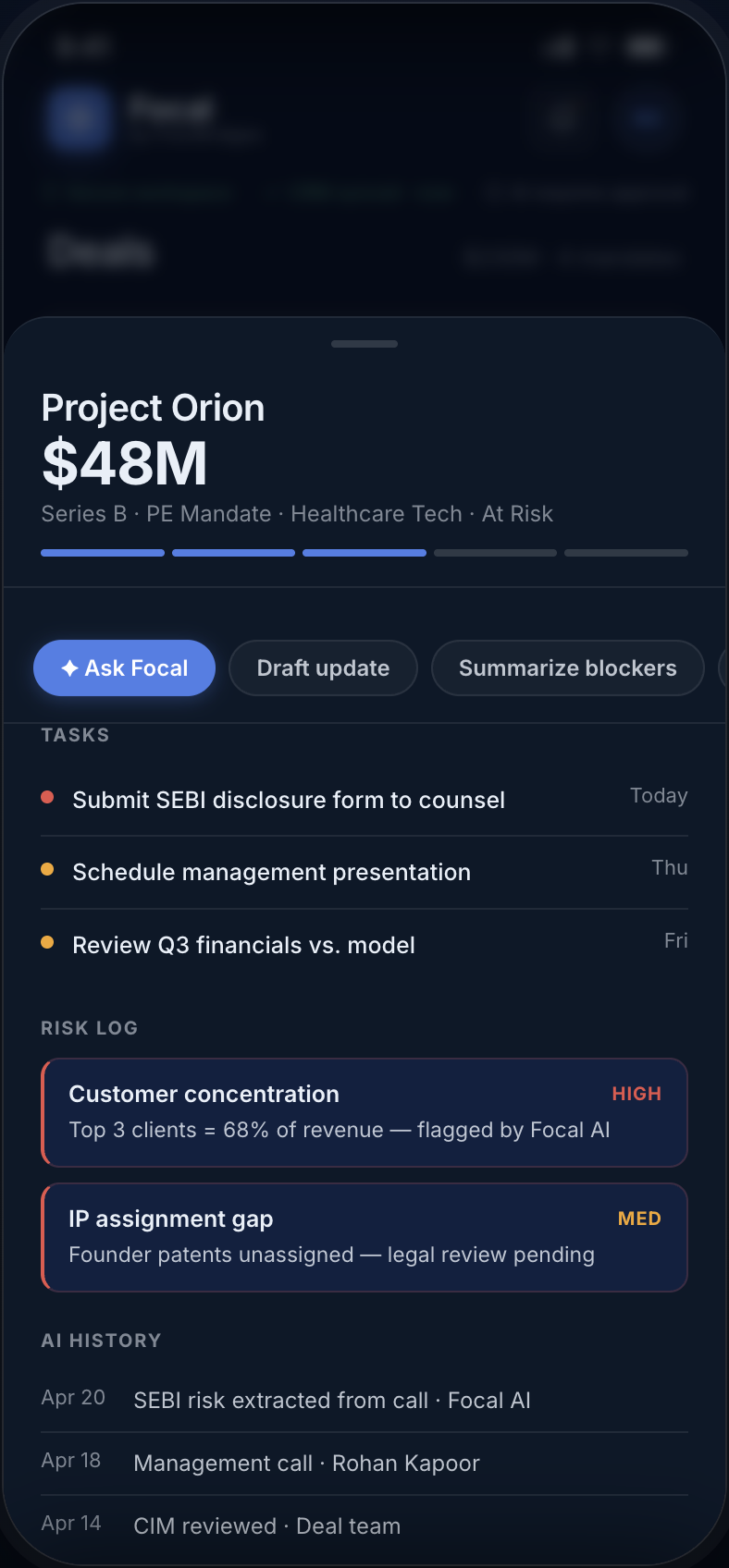
The product started as a desktop dashboard. It's now a mobile-first app. That shift wasn't a rebrand — it was the product finding where it actually belongs.
The earlier version of this product was built for a desktop browser. It had a command center, a deal tracker, an AI changes panel, and a full analytics view. It was well-designed. It was never going to get used.
The observation that drove the pivot was simple: the people who needed this tool most never sat at a laptop when they needed it. A deal update happens in a cab, on a call, walking between meetings. The desktop wasn't wrong — it was just not where the work happened.
🔄
Desktop app vs. mobile-first product — which is the right surface?
What we decided
Mobile-first, always. Not a responsive version of the desktop app — a product designed ground-up for a 390px screen, with the phone's native affordances (microphone, camera, notifications) at the center of the interaction model.
The desktop version tried to solve the right problem in the wrong context. Switching the primary surface from desktop to phone wasn't a design decision — it was an observation about where actual work happens, finally acted on.
The rebuild also gave us the chance to simplify. The desktop version had a lot of surface area — it tried to be everything. The mobile version started from a single constraint: what is the one thing this product has to do well? The answer was voice input to structured output. Everything else is secondary.
Focal is built around a single loop: input → extract → propose → confirm → update. Every screen exists to serve one stage of that sequence.
The architecture came from asking: what's the minimum viable interaction that converts a spoken thought into a structured record? The answer was a five-step loop that couldn't be shortcut.
The five-step loop
01 · Input
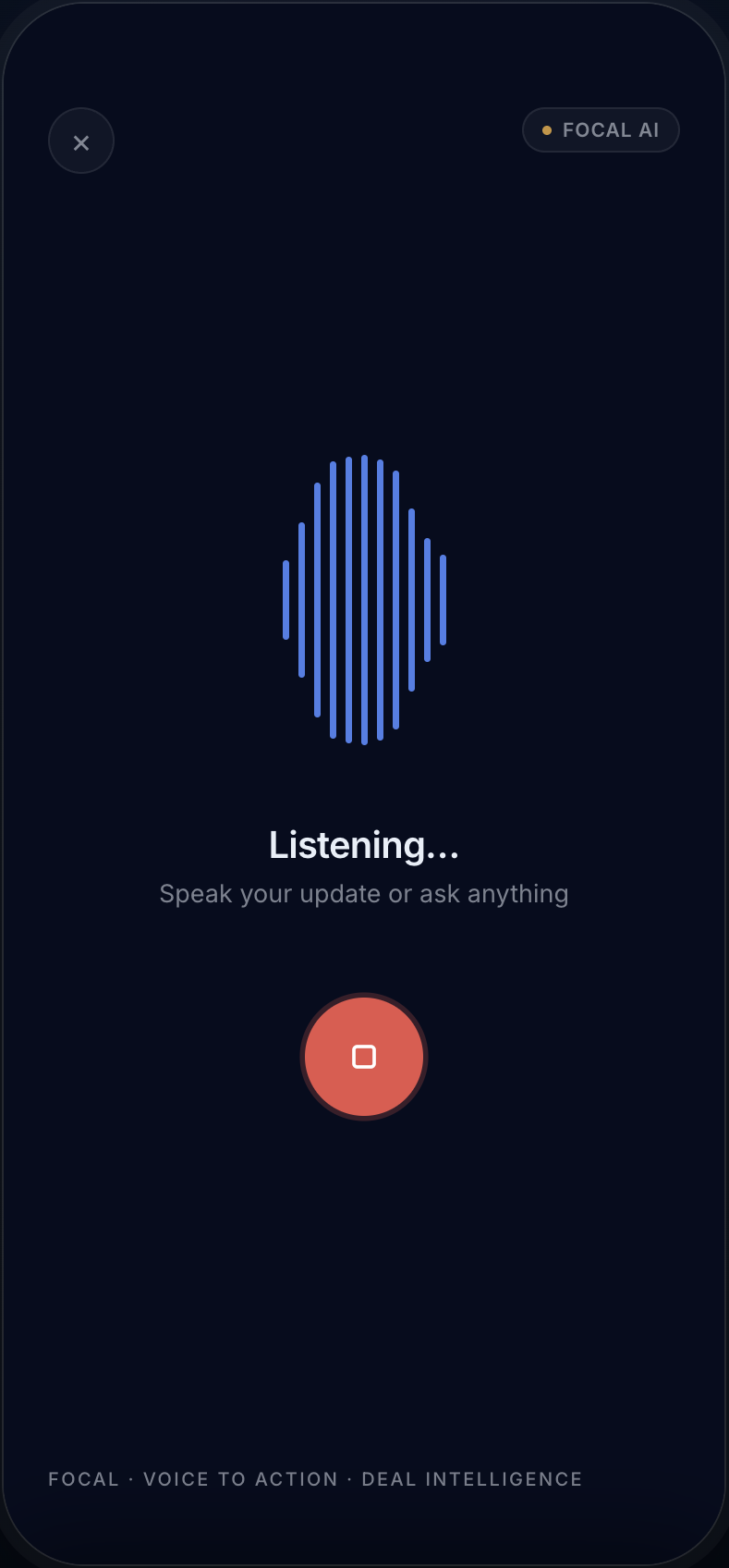
Voice recording, audio file upload, or quick text. All three formats enter the same pipeline. No special handling required from the user.
02 · Extract
AI transcribes and parses the input — identifying deal references, stage changes, task owners, deadlines, risk signals, and compliance flags.
03 · Propose
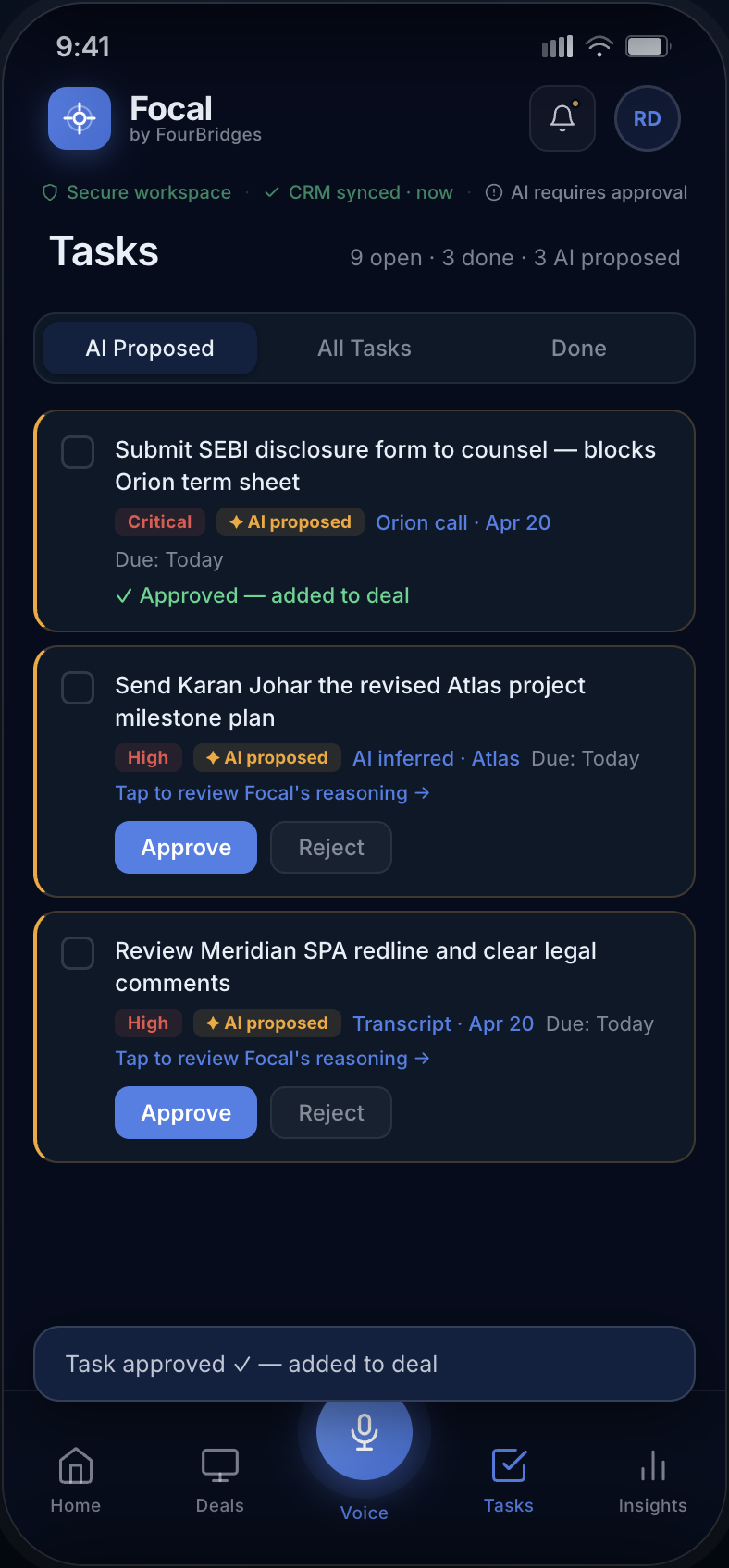
Extracted items surface as discrete proposed changes. Each one shows its source (transcript segment or timestamp) and a confidence signal.
04 · Confirm
The user reviews and approves or dismisses each proposed change. Nothing touches the deal record until explicit confirmation.
05 · Update
Confirmed changes write to the deal record, task list, and team activity log. The source input is preserved and linked for traceability.
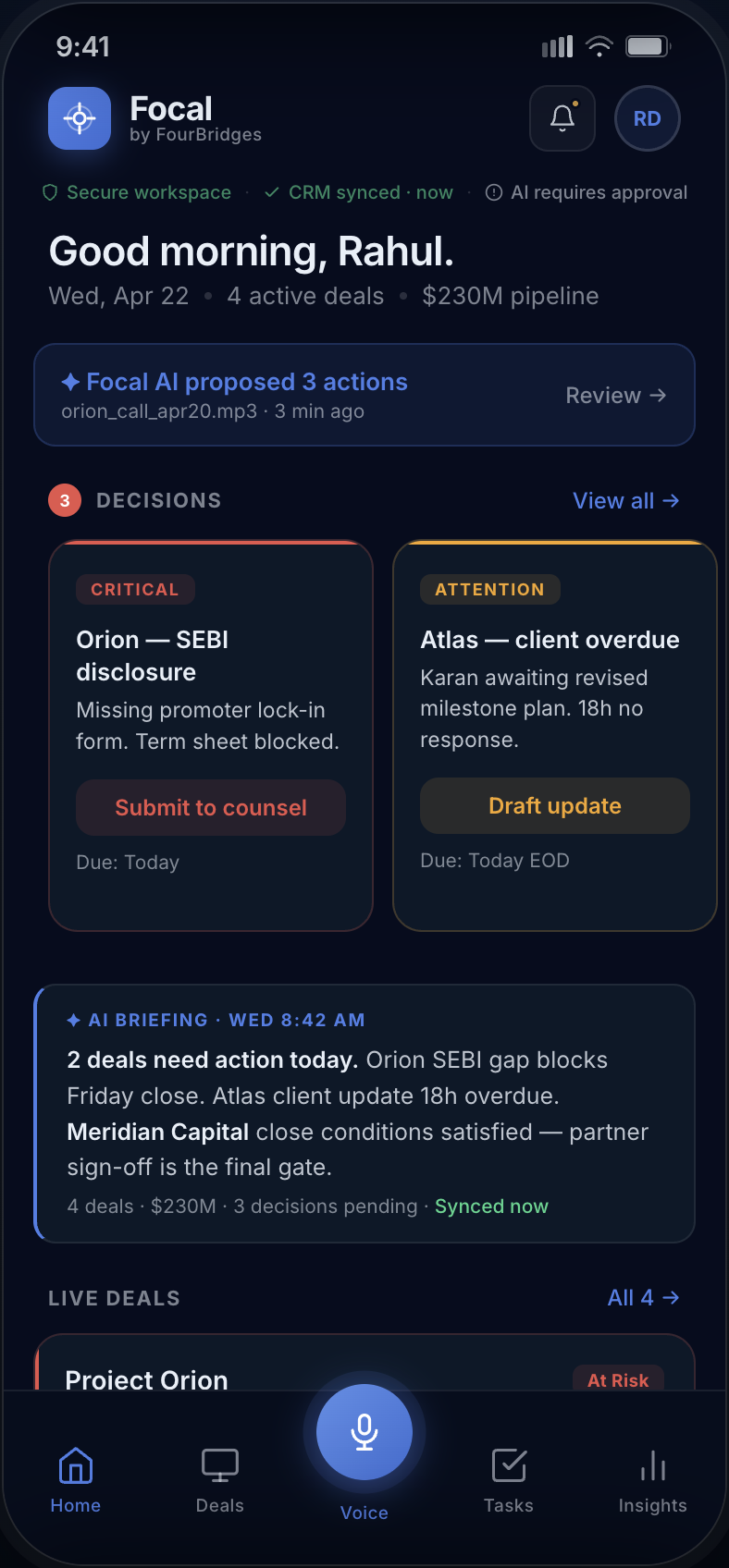
Five screens carry this loop: the Dashboard (priority surface), Voice (input), Proposals (review queue), Tasks (confirmed + pending), and Deals (live deal state). A sixth screen — Insights — sits outside the loop and aggregates activity over time.
P01
Voice is the primary input — always
The central nav button is a microphone. Typing is supported but never the implied default. The product leads with the behavior finance professionals already have.
P02
Priority first — not chronology
The dashboard shows what needs attention now, not what happened most recently. Risk, delay, and pending AI changes surface before routine updates.
P03
AI proposes, human confirms — always
The loop requires explicit human approval before any deal record is updated. The architecture treats silent AI writes as a design failure, not a feature.
P04
Source always visible
Every AI proposal shows the transcript segment it came from. If you can't see why the AI proposed something, you can't evaluate whether it's right.
The decisions that shaped Focal were mostly about what to leave out — and where to keep the human in control.
⚡
Should the AI update the deal record directly, or require human confirmation every time?
What we chose
Human-in-the-loop for every AI inference, without exception. No silent updates. No confidence threshold that bypasses confirmation. Every proposed change waits for explicit approval.
In a compliance-sensitive, high-stakes environment, the cost of a wrong AI inference reaching the deal record is higher than the friction of a confirmation tap. Trust in an AI system builds incrementally. A system that shows its work earns the right to do more — eventually.
🔔
Should the app surface everything or filter to priority?
What we chose
Ruthless prioritization over completeness. The dashboard never shows all deals or all tasks — only those with risk flags, delays, or pending AI changes. The full view is always one tap away.
Finance professionals have no patience for a dashboard that requires scanning. If everything is on the surface, nothing is. The product earns attention by respecting it — showing only what actually needs action.
📋
Onboarding — how much setup is acceptable before first value?
What we chose
Minimal onboarding, maximum first-session value. The onboarding flow imports existing deal context first, so the dashboard is populated before the user ever speaks their first update.
An empty dashboard is the fastest path to abandonment. The first session had to feel like the product already understood the firm — not like the user was starting from scratch.
Focal is an active prototype being refined through real workflow observation. The next step is controlled — building a private internal AI voice agent to test, learn, and protect what matters.
Current status
The prototype is live and being used inside Four Bridges in real working conditions. Voice input, AI extraction, and the confirmation flow have gone through multiple rounds of iteration based on observed usage — not hypothetical feedback. The core loop works. The refinement now is around trust, speed, and the specific language patterns of finance professionals.
What's being refined
Real usage surfaces things no prototype session ever will: which AI proposals get dismissed and why, how long users take before confirming, which deal contexts the extraction model struggles with. Every round of real use makes the proposal quality measurably better — and makes the confirmation UX feel less like a checkpoint and more like a routine.
→
Next step
The next phase is building a private internal AI voice agent — not a public product, not a third-party integration, but a controlled internal system the team owns entirely. The goal is to test real daily usage, measure how the workflow improves, and keep all company data and deal context protected inside the firm. No sensitive business information exposed to external tools. No dependency on consumer AI infrastructure. A system that earns trust the same way Focal's confirmation UX does — one verified interaction at a time.